
What is a prolapsed stoma?
Sometimes the bowel can extend in length, similar to a telescope effect, and this is called a prolapsed stoma. Despite the prolapse, your stoma should continue to be a healthy pink/red colour and it should function in the usual manner. If things alter in any way and your stoma becomes darker it is important that you seek urgent medical advice by calling your GP, calling 111 or attending your local A&E department.
If the stoma prolapses, but is healthy and active, it will invariably get bigger in size, so therefore it is important to check your template frequently as it may be necessary to use a larger stoma bag to accommodate the stoma. It would be helpful for you to check this with your Stoma Care Nurse
How common is a prolapsed stoma?
Stoma prolapse is one of the more common stoma complications. It is more frequently seen in colostomies than in ileostomies or urostomies, and loop stomas - where a loop of bowel is brought to the surface - are more prone to prolapse than end stomas.
Prolapse can occur at any time after surgery, including many years later. While it can be unsettling to notice, it does not always require surgical intervention and can often be managed effectively with the right products and techniques.
What causes a prolapsed stoma?
A stoma can prolapse if the muscles supporting it are weak or it may happen as a result of straining the abdominal muscles i.e. through lifting.
Any activity that causes an increase in intra-abdominal pressure - such as coughing or sneezing can cause a stoma to prolapse, therefore if you are suffering with a nasty cough or cold, try to gently support your abdomen when you cough or sneeze by simply holding the area firmly.
Factors such as heavy lifting, being overweight, or weak abdominal muscles can place stress on your abdomen following surgery. To help manage this, your stoma care nurse may recommend a support garment. Rather than preventing internal stoma changes, these belts are used to physically support your abdominal wall, secure your pouching system, and significantly reduce the heavy "dragging" sensation when your bag fills.
Can a prolapsed stoma be painful?
A prolapsed stoma should not usually cause you any pain or affect the way your stoma functions, although it may cause issues when it comes to fitting your stoma bag correctly due to the size and weight of the prolapsed stoma.
Is a prolapsed stoma dangerous?
As a rule, a prolapsed stoma is not dangerous or a medical emergency. However, you should seek urgent medical advice if you notice any of the following:
- Your stoma changes from its usual pink/red colour to a darker red, purple or black
- You experience significant pain at or around the stoma site
- The stoma does not reduce in size when you lie down, or appears to be getting larger rapidly
- The prolapse cannot be gently reduced (pushed back) as it usually can
- You notice bleeding from the stoma that is not related to normal contact during bag changes.
- Your stoma stops working as a result of the prolapse.
If you are ever in doubt, contact your Stoma Care Nurse or seek medical advice promptly.
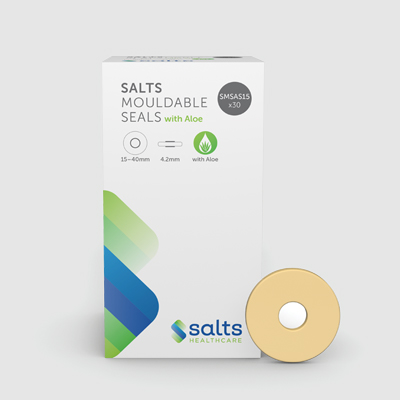
The use of mouldable seals and barrier films can be helpful to protect this exposed skin:
Salts Mouldable Seals with Aloe
Salts Barrier Film Wipes
View Product

Please note: If you are worried that you might have a prolapsed stoma, you should always seek advice from your Stoma Care Nurse.
How to help manage your prolapsed stoma
It is often advised that your template size should be cut 5mm larger if you experience stoma prolapse to try prevent rubbing against the aperture of your stoma bag or trauma to the bowel when the stoma prolapses.
Lying down may reduce the size of the prolapse, and may make it easier to apply your bag. In some cases the use of a support belt, applied whilst lying down, can be effective in managing the prolapse.
Your Stoma Care Nurse can advise you on the use of a support garment or ostomy belt.
Can a prolapsed stoma be pushed back in?
In many cases, a prolapsed stoma can be gently reduced - meaning the extended bowel can be carefully eased back to its normal position. This is usually easiest when you are lying down, as gravity helps the prolapse to reduce naturally.
If you need to manually reduce the prolapse, your Stoma Care Nurse can show you a safe technique. In general:
- Lie flat on your back and allow a few minutes for the prolapse to reduce on its own.
- If it does not reduce by itself, gently apply steady, even pressure with a clean hand, working from the tip of the prolapse inwards.
- Never force the stoma back if it is resisting - seek medical advice instead.
- Applying a small amount of sugar to the surface of the prolapsed stoma can help draw out excess fluid and make reduction easier. This should only be done on the advice of your Stoma Care Nurse.
If your prolapse is not reducible, is causing pain, or has changed colour, seek urgent medical attention.
Living with a prolapsed stoma: surgery and day-to-day management
Many people manage a prolapsed stoma successfully without needing surgery. For mild to moderate prolapses, conservative approaches - including support garments, template adjustments and careful bag-change technique - are often enough. Surgery tends to be considered only when the prolapse is large or frequent, cannot be reduced, shows signs of compromised blood supply, or is significantly affecting quality of life. Any decision will be made jointly with your surgical team, and your Stoma Care Nurse can refer you for a surgical review if they feel it is warranted.
Overall, it’s important to remember that a prolapse does not have to stop you living fully. However, adjusting your routine a little can certainly help. Keeping spare supplies to hand is sensible, for example, as bag changes may be needed more frequently when the prolapse is active. If the prolapse is affecting your confidence or emotional wellbeing, our Ostique Connect community is a valuable source of peer support from people with first-hand experience.
 medilink.png)
Register with the Medilink® Home Delivery Service
Get your stoma bags and additional products delivered directly to your home with Medilink®, our stoma prescription dispensing and home delivery service.
Sign up to our monthly e-Newsletter!
Subscribe NOW to our newsletter and be kept up-to-date with all things Salts Healthcare.