
.png)
What to expect immediately after colostomy surgery
Waking up attached to various tubes and monitors can be unnerving, but it is entirely routine. You may have:
- A drip into a vein in your arm, giving you fluids.
- A catheter draining your bladder.
- An oxygen mask or nasal tubes to help you breathe comfortably.
- A drain near your wound.
None of these stay in for long. They are taken out one by one as you recover, and removing them causes far less discomfort than most people expect.
You will also have a bag over your new stoma straight away. This first bag is usually clear and larger than the one you will end up using day to day, so that staff can see your stoma clearly and check its colour and size without disturbing you. Not every hospital does this, so don't worry if yours looks different.
Not every hospital does this, so don't worry if yours looks different.
What is the supporting rod under a loop colostomy?
If you have had a loop colostomy formed, you may notice a small rod or bridge sitting underneath the stoma. Its job is simply to hold the loop of bowel in place while everything settles.
It is usually only needed for the first few days. Your team will remove it when the time is right, and this is generally quick and causes little discomfort.
How long will I be in hospital after colostomy surgery?
Most people spend a few days in hospital after a colostomy, although this varies with the type of operation you had, whether it was open or keyhole surgery, and how your recovery goes.
Much of that time is spent getting you moving, eating and drinking again, and helping you become confident with your stoma. Staff will encourage you to get out of bed and walk short distances early on, which helps prevent complications and speeds up recovery. Your Stoma Care Nurse will start teaching you how to look after your stoma while you are still on the ward, and you will usually not be discharged until you and your team are happy that you can manage.
When will my colostomy start to work?
Your colostomy will usually begin working within a few days of the operation. There is no set timeframe, and it is very common for it to take a little longer than you expect while your bowel wakes up after surgery.
A few things to expect in those first days:
- You will have no control over when your colostomy works, and you may not feel it happening at all.
- Output is often quite loose to begin with, and thickens as you start eating properly again.
- Wind is common early on and usually settles as your stool thickens.
Not feeling your colostomy work takes some adjusting to, but it becomes much less unsettling once checking your bag becomes part of your routine.
Will my colostomy make a noise?
It might, particularly in the early weeks. Wind is a normal part of the bowel working, and a new colostomy can be noisier than you would like at first.
This nearly always calms down as your stool thickens and your diet returns to normal. If wind or ballooning is bothering you, a bag with an effective filter can make a real difference, and your Stoma Care Nurse can help you find one that suits you.
What type of stoma bag will I be wearing?
To begin with you will usually wear a drainable bag, because early output tends to be liquid and a drainable bag can be emptied rather than replaced each time. It will normally be clear, or have a viewing window, so your Stoma Care Nurses and ward staff can keep an eye on your stoma without removing anything. They will empty it for you at first, and then show you how to do it yourself once you are feeling well enough.
Below you can find links to our closed and drainable stoma product range:


What is a colostomy bag?
A colostomy bag is a discreet pouch worn over your stoma that collects faecal matter as it leaves the large bowel through the opening in your abdominal wall. It sticks to the skin around your stoma and is first put on shortly after your operation. It is designed to be secure, to control odour and to sit unobtrusively under clothing.
Modern bags are far flatter and quieter than most people imagine before surgery, and they are made to sit comfortably against the skin for hours at a time.
Closed or drainable: which type will I use?
The two main options work differently:
- A closed bag is removed and replaced with a fresh one when it needs changing. Most people with a colostomy move on to closed bags once their output has thickened.
- A drainable bag has an opening at the bottom so it can be emptied and reused for a while. These suit looser output, which is why they are commonly used straight after surgery.
Your Stoma Care Nurse will guide you on when to switch and which product suits your stoma, your skin and your routine. It is normal to try a few before settling on the one that works for you, and you can request free samples at any point.
Changing your colostomy bag after surgery
Once your output has thickened, your Stoma Care Nurse will usually suggest moving from a drainable bag to a closed one, which you change rather than empty.
Our guides on changing your stoma bag and wearing your stoma bag walk through the practical steps in detail.
How often will I need to change my colostomy bag?
After a few weeks, most people settle into changing their bag after a bowel motion, which typically works out at somewhere between one and four times a day.
That is a wide range, and where you land within it is personal to you. It depends on your surgery, your diet and how your bowel behaved before your operation. There is no correct number, and comparing yourself to someone else with a colostomy is rarely helpful.
Learning to change your bag yourself
The first few changes you do on your own can feel daunting. It does get easier with practice, and for most people it becomes a routine part of the day. There is no set timescale, so go at your own pace. A few things that help in the early days:
- Give yourself plenty of time rather than rushing the first few changes.
- Lay out everything you need before you start.
- Change your bag at a quieter point in the day, when output is less likely.
- Keep a spare bag and a few supplies with you when you go out.
- Sit or stand in front of a mirror if it helps you see what you are doing.
If something is not working, whether that is leakage, poor adhesion or an awkward stoma position, tell your Stoma Care Nurse rather than putting up with it. There is usually a product or an accessory that solves it.
Sensations you may notice after colostomy surgery
Some of the most common worries in the early weeks are about sensations that feel wrong but are, in fact, entirely expected.
Passing mucus or old stool from your bottom
If your rectum has been left in place, you may still feel the urge to open your bowels in the usual way, and you may pass a little mucus or some old stool when you sit on the toilet.
The lining of the bowel produces mucus naturally and continues to do so even though stool no longer travels that way, so it can build up and needs to come out from time to time. It may look sticky or cloudy, and shortly after surgery it can be darker in colour. This usually settles down, but mention it to your GP, consultant or Stoma Care Nurse if it carries on or becomes uncomfortable.
Sometimes the mucus or old stool can be difficult to pass. Sitting on the toilet and letting it come away in its own time can help, but try not to strain or force it. If it still won't pass, speak to your Stoma Care Nurse, GP or consultant, as in some circumstances a suppository may be needed to help clear it.
What is phantom rectum?
If your rectum has been removed and your anus closed, you may still get a strong sensation that you need to open your bowels. This is known as phantom rectum, and it happens because the nerves in that area continue sending familiar signals to your brain.
It is harmless, though it can be disconcerting the first time. Many people find that simply sitting on the toilet for a few minutes until the feeling passes is enough. If it becomes persistent or distressing, your Stoma Care Nurse can suggest ways to manage it.
Constipation after a colostomy
Because a colostomy is formed from the large bowel, constipation is still possible, and if you were prone to it before your surgery there is a reasonable chance you will experience it again.
The usual measures apply:
- Drink plenty of fluid throughout the day.
- Build fibre back into your diet gradually, as advised by your team.
- Stay as active as your recovery allows.
If it does not resolve, speak to your GP or Stoma Care Nurse before reaching for laxatives, as they can advise on what is appropriate for you.
Looking after the skin around your stoma
The skin immediately around your stoma, known as the peristomal skin, should look the same as the skin anywhere else on your abdomen. If it becomes red, itchy or sore, that is a signal worth acting on rather than living with.
Sore skin is most often caused by output getting underneath the adhesive. Common reasons include:
- The aperture has been cut slightly too large, leaving skin exposed.
- Your stoma has shrunk since surgery, so your template no longer fits.
- The bag is not sitting flush against a dip, crease or scar.
- The adhesive is being removed too quickly or too often.
Our skin care guidance covers how to keep the area healthy. Your stoma will shrink over the first few weeks, so ask your Stoma Care Nurse to re-measure it and reassess your template rather than assuming your original size still fits.
Eating and drinking in the first few weeks
Most people with a colostomy return to a normal diet fairly quickly, often within days of the operation, though how fast you progress will be guided by your surgeon and dietitian.
In the first few weeks, while your bowel is still swollen and healing, it can help to keep things simple:
- Eat smaller meals more often rather than a few large ones, and chew thoroughly.
- Go easy on very high-fibre foods at first, such as skins, pips, nuts, beans, pulses and raw salad, until your output settles.
- Reintroduce foods one at a time so you can tell what agrees with you and what does not.
- Drink plenty of fluid throughout the day.
This is a temporary phase, not a permanent restriction. Fibre matters for long-term bowel health and helps prevent constipation, so it should be built back in gradually as your output thickens. Our dietary and nutritional advice covers this in more detail, and a dietitian can help if you are struggling.
Getting back to normal after colostomy surgery
Recovery is not a straight line, and having a good day followed by a tired one is completely normal. As a rough guide:
● Gentle walking: encouraged from the first days, building up slowly.
● Heavy lifting and strenuous activity: usually built back up from around eight weeks.
● Driving: once you have recovered and could make an emergency stop comfortably.
● Returning to work: varies widely depending on your job and your surgery.
These are general ranges only. Your surgeon and Stoma Care Nurse know your operation and their advice always takes priority over anything you read here.
Lifting, exercise and protecting your tummy muscles
Your abdominal muscles need time to heal, and building your activity back up gradually helps them recover and lowers the risk of a parastomal hernia.
NHS guidance is that your tummy muscles need around eight weeks to heal before you return to heavy lifting and strenuous activity, although your surgeon may advise differently depending on your operation. Gentle movement is encouraged from early on: a short walk and some gentle core exercises, building up slowly as you feel able, do far more good than resting completely. Our training and exercise section covers returning to activity safely, and your Stoma Care Nurse can advise on support garments if required.
When can I drive after colostomy surgery?
The usual test is whether you could perform an emergency stop without hesitating because of your wound. In practice that tends to be somewhere around six weeks, but it varies and your GP or consultant should confirm that you are fit to drive.
It is also worth a call to your insurer before you get behind the wheel, as some policies have conditions about driving after surgery.
Going back to work
When you return depends on the surgery you had and what your job involves. Office-based work is often manageable sooner than physically demanding work, and many people find easing back in on reduced hours works better than going straight back full time.
Talk it through with your Stoma Care Nurse or consultant first, particularly if your role involves heavy lifting or long periods without easy access to a toilet. Your GP can provide a fit note to cover your time off.
Medicines and your colostomy
Most medicines are absorbed before they reach the large bowel, so a colostomy does not usually affect how well they work. Occasionally, some slow release or coated tablets may not be fully absorbed, particularly if your colostomy is higher up the bowel or your output is looser than usual.
If you notice whole or partly dissolved tablets in your bag, mention it to your GP or pharmacist. There is often an alternative in liquid or another form. Do not stop taking any prescribed medicine without speaking to a healthcare professional first.
When should I contact my Stoma Care Nurse?
Your Stoma Care Nurse is there for the whole of your journey, not just the days immediately after surgery, and no question is too small. Most stoma care teams are not available at night or at weekends though, so some problems should not wait. Seek urgent medical attention if:
● Your stoma changes colour, particularly if it turns dark, purple or black, or feels cold and hard.
● Your stoma has not worked at all for an extended period, especially alongside cramping, a swollen tummy, nausea or vomiting.
● There is more than a small amount of bleeding from the stoma, or bleeding that does not stop.
● Your wound becomes increasingly painful, hot, red or starts to discharge.
Call NHS 111, or call 999 or go to A&E if you feel very unwell. Do not wait to speak to your Stoma Care Nurse first.
Get in touch with your Stoma Care Nurse if:
● The skin around your stoma is red, broken or sore, or you have repeated leaks.
● You develop a bulge around your stoma, or the stoma itself changes shape or size noticeably
You can also read more about the problems you may experience and how to manage them. If you are finding things difficult emotionally, which is extremely common in the first months, our guidance on emotional challenges and our stoma support groups page may help.


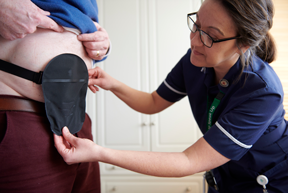

Helpful videos to prepare you for your colostomy operation
We have created a series of ‘how to’ video guides for people living with a colostomy. These videos are available to view and download.

Living with a stoma
Let us help you with every aspect of living with a stoma, from those first few weeks after surgery through to everyday lifestyle advice on diet, exercise, relationships and travel.