
.png)
What is a colostomy?
A colostomy is a surgically created opening from your large bowel to the surface of your abdomen. It provides a new path for waste material to leave your body after part of the large bowel has been removed. This generally produces a formed stool, however this can vary.
A colostomy bag is worn over the stoma to collect your stool. If you are new to stoma surgery, our guide to what a stoma is, is a helpful place to start.
Info: A colostomy is usually on the left-hand side of your body, but in some circumstances may be formed on the right-hand side.
What are the different types of colostomy?
You will either have an end colostomy or a loop colostomy.
The type of colostomy you have will depend on the reason for your surgery. Your Surgeon will explain which is most suitable for you before your operation, and both types are explained in more detail below.
What is an end colostomy?
An end colostomy is formed when part of the large bowel and/or the rectum are removed. The remaining large bowel is brought out to the surface of the abdomen to create a stoma.
This can be temporary or permanent.
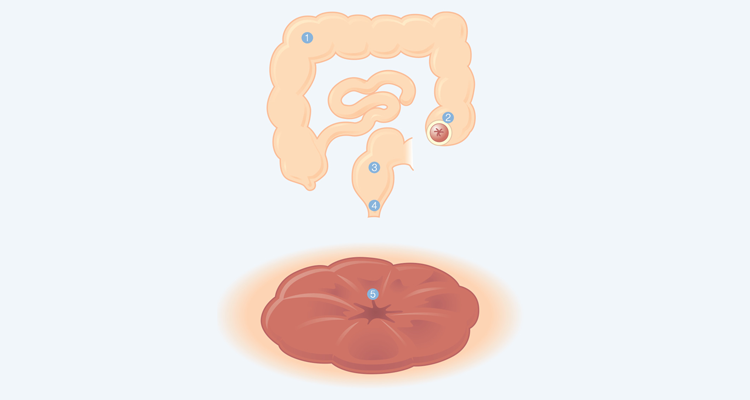
The digestive system:
 Large bowel
 Colostomy
 Rectum
 Anus
Anus Stoma
Stoma
What happens if an end colostomy is created?
If an end colostomy is created, a diseased section of large bowel is removed. The remaining bowel isn't rejoined straight away, because your surgeon has decided it wouldn't be safe or appropriate to do so at this time.
However, it may be possible to re-join your large bowel in the future, and this can be discussed with your surgeon.
What is a loop colostomy?
A loop colostomy is usually created to protect a surgical join in the large bowel or to divert the flow of stool from an obstruction.
It is formed when a loop of the large bowel is brought to the surface of the abdomen and opened to form a stoma. This can be temporary or permanent.
A loop colostomy has two openings; only one of these will pass stool, the other may produce mucus.
A loop colostomy can be situated anywhere within the large bowel depending on your situation.
Common sites are pictured on the diagram.
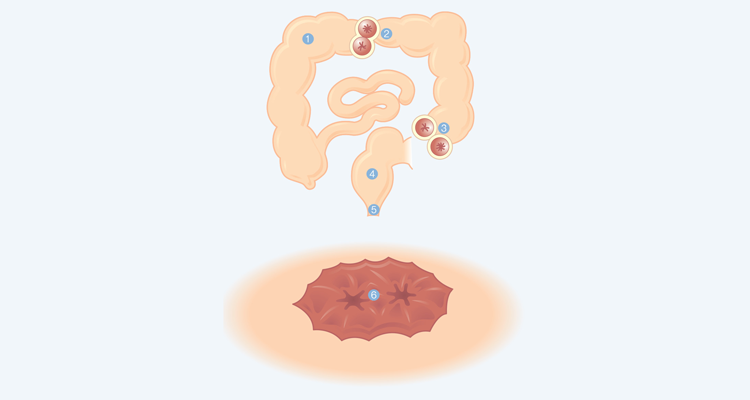
Two common sites where you may find loop colostomy situated
Loop colostomy diagram:
- Large bowel
- Transverse loop colostomy
- Sigmoid loop colostomy
- Rectum
- Anus
- Loop stoma
What is the difference between a colostomy and ileostomy?
A colostomy is formed from the large bowel (colon) and is usually positioned on the left-hand side of your abdomen. Because stool has passed through most of the digestive system before it reaches the stoma, the output is generally formed.
An ileostomy is formed from the small bowel (ileum) and is usually positioned on the right-hand side of your abdomen. Normally, the large bowel absorbs water from digested food to form solid stool. Because an ileostomy bypasses the large bowel, the output tends to be looser. You can learn more about what an ileostomy is in our guide.
Why might I need a colostomy?
Your operation may need to be performed for a variety of reasons and your Surgeon and Specialist Nurse will explain these to you.
There are a number of different diseases and conditions that can result in the need for a colostomy, such as:
- Crohn’s Disease
- Diverticular Disease
- Faecal incontinence
- Cancer
- Trauma
- Radiation damage
- Congenital abnormalities
How is colostomy surgery performed?
Colostomy surgery is carried out under general anaesthetic, either as open surgery or as keyhole (laparoscopic) surgery. Your Surgeon will explain which approach is planned for you and why.
Before your operation, your Stoma Care Nurse will usually mark the best position for your stoma on your abdomen, taking into account your body shape, clothing and lifestyle. You can find more information about getting ready for your operation in our before your stoma surgery section.
Is a colostomy permanent or temporary?
A colostomy can be either permanent or temporary, depending on the reason for your surgery.
A temporary colostomy gives your bowel time to heal, while a permanent colostomy is usually needed when the lower part of the bowel or the rectum has been removed. Your Surgeon and Stoma Care Nurse will talk this through with you before your operation, so you know what to expect.
Can a colostomy be reversed?
If your colostomy is temporary, it may be possible to reverse it with a further operation once your bowel has healed. A reversal involves re-joining the bowel so that stool passes through your digestive system in the usual way again.
Not every colostomy can be reversed, and the timing varies from person to person. Whether and when a reversal is appropriate will be assessed by your Surgeon on an individual basis, so it is always worth discussing this with them.
Will I still pass anything from my bottom?
If your rectum and anus are still in place, it is normal to occasionally pass mucus from your bottom. The lining of the bowel produces mucus naturally, and this can build up even though stool no longer passes through.
This is nothing to worry about, but if it becomes uncomfortable or you have any concerns, speak to your Stoma Care Nurse.
What will my colostomy look and feel like?
Your colostomy may be flat to your abdomen or it may stand out slightly. It will be soft to touch, pinkish-red in colour and moist; rather like the inside of your mouth.
There is no sensation in the stoma, so it is not painful. However, it has a rich blood supply and it is normal for it to bleed a little from time to time, especially when cleaning.
Your colostomy is likely to be swollen at first and will take a few weeks to reduce in size.
There will be small stitches around the edge of your colostomy, which will either be dissolvable or your Stoma Care Nurse will remove them 1-2 weeks after your operation.
What is a colostomy bag?
A colostomy bag is a discreet pouch worn over your stoma to collect stool. People with a colostomy usually use a closed stoma bag, which is removed and replaced with a fresh bag when needed, although your Stoma Care Nurse will help you find the right product for you.
You can browse our full range of stoma bags and supporting products and request free samples to try before your surgery or during your recovery.
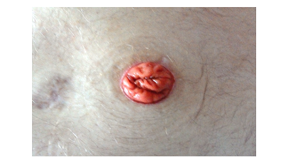
End Colostomy
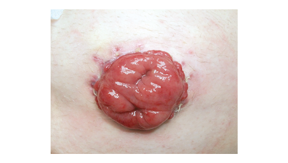
Loop Colostomy
What is a colostomy bag?
A colostomy bag is a discreet pouch worn over your stoma to collect stool. People with a colostomy usually use a closed stoma bag, which is removed and replaced with a fresh bag when needed, although your Stoma Care Nurse will help you find the right product for you.
You can browse our full range of stoma bags and supporting products and request free samples to try before your surgery or during your recovery.

Helpful videos to prepare you for your colostomy operation
We have created a series of ‘how to’ video guides for people living with a colostomy. These videos are available to view and download.

What to expect after your colostomy surgery
Find out more information about what you can expect after your stoma surgery including; how your stoma works, how to change a stoma bag, taking care of your skin and much more.
Once you are recovering, our advice on diet and nutrition with a stoma explains how different foods can affect your stoma output in the weeks after your operation and beyond.
Register with the Medilink® Home Delivery Service
Get your stoma bags and additional products delivered directly to your home with Medilink®, our stoma prescription dispensing and home delivery service.
FIND OUT MORE ABOUT MEDILINK
 medilink imagery.png)
Register with the Medilink® Home Delivery Service
Get your stoma bags and additional products delivered directly to your home with Medilink®, our stoma prescription dispensing and home delivery service.